
Corroboree Conservation

Conservation Of Corroboree Frogs

Both Corroboree Frog species have been rapidly declining since the mid 1980’s. The Southern Corroboree Frog has now declined from more than 98% of its former range and is likely to become extinct in the wild within the next five years unless action is taken. The Southern Corroboree Frog is listed Endangered in Australia and as Critically Endangered by the International Union for the Conservation of Nature (IUCN).

The Northern Corroboree Frog has also undergone substantial declines across its range. The decline of the Northern Corroboree Frog has been particularly severe in the Brindabella Ranges, where it has become almost entirely extinct from the Australian Capital Territory. The Northern Corroboree Frog is listed as Vulnerable by the Australian and New South Wales Governments and is as Endangered by the International Union for the Conservation of Nature (IUCN).

Why Should We Save Corroboree Frogs?

Corroboree Frogs are an iconic Australian species and are important to our natural heritage. Given their uniqueness and inherent value to our nation, it would be a tragedy if the Corroboree Frogs became extinct and future generations were deprived of being able to see these remarkable creatures.

Worldwide, amphibian have declined and become extinct at a greater rate over the past fifty years than birds, reptiles and mammals. Saving the Corroboree Frogs will represent a major achievement for the conservation of amphibians around the world. Australia alone has seen the extinction of eight frog species in recent decades, with the Southern Corroboree Frog predicted to be the ninth if we don’t intervene.

We have the opportunity to save an important part of Australian culture that is also one of the world's most endangered frogs. You can help us to ensure we don’t let this chance pass us by.

Why Are Corroboree Frogs Declining?

photo-9.jpg

The decline of Corroboree Frogs, and many other frog species throughout Australia, is mainly due to a disease known as chytridiomycosis, which is caused by infection with the Amphibian Chytrid Fungus (Batrachochytrium dendrobatidis). The Amphibian Chytrid Fungus was only recently introduced into the Australian environment, which is why many of Australia’s frog species have limited resistance to this pathogen. Corroboree Frogs have been shown to be very susceptible to the fungus in the laboratory.

In the wild the Amphibian Chytrid Fungus can be transferred by the Common Eastern Froglet (Crinea signifera, Pictured). While the Common Eastern Froglet is not susceptible to disease caused by the Amphibian Chytrid Fungus, it becomes infected with the pathogen, and spreads it throughout breeding habitats used by the Corroboree Frogs. The Amphiban Chytrid Fungus is believed to have originated from South Africa, and is likely to have been introduced into Australia on the African Clawed Frog (Xenopus levis), which were exported around the world by pharmaceutical companies to carry out tests.

For more information about Chytrid fungus click here

Other Threats to Corroboree Frogs

photo-10.jpg

While disease caused by the Amphibian Chytrid Fungus is the primary factor driving the decline of the Corroboree Frogs, a range of other factors are also affecting these species and contributing to their decline. A reduction in the extent of bog habitats as a result of the historic grazing of cattle in the high country would have greatly reduced the amount of breeding habitat for Corroboree Frogs.

Drought also impacts on the Corroboree Frogs by affecting their breeding activities and causing early pool drying which results in the death of tadpoles. The impact of drought may be particularly severe in the future if climate change results in an increase in the frequency and severity of droughts in the high country.

In some areas of the Northern Corroboree Frogs range, reduced rainfall has resulted in breeding pools becoming overgrown with vegetation and they are no longer suitable as breeding sites. Feral animals, such as pigs and horses, may also damage the breeding habitats of Corroboree Frogs and impact on these species.

What Is Being Done To Save Corroboree Frogs?

Since 1995, Corroboree Frogs have been the focus of an intensive Recovery Program aimed at preventing the extinction of these species. This recovery program is carried out by a team of scientists and managers with expertise in frog ecology, husbandry and conservation management. A Recovery Plan was produced for the Southern Corroboree Frog to help guide this program (click here to download this plan).

How Can We Save The Corroboree Frogs?

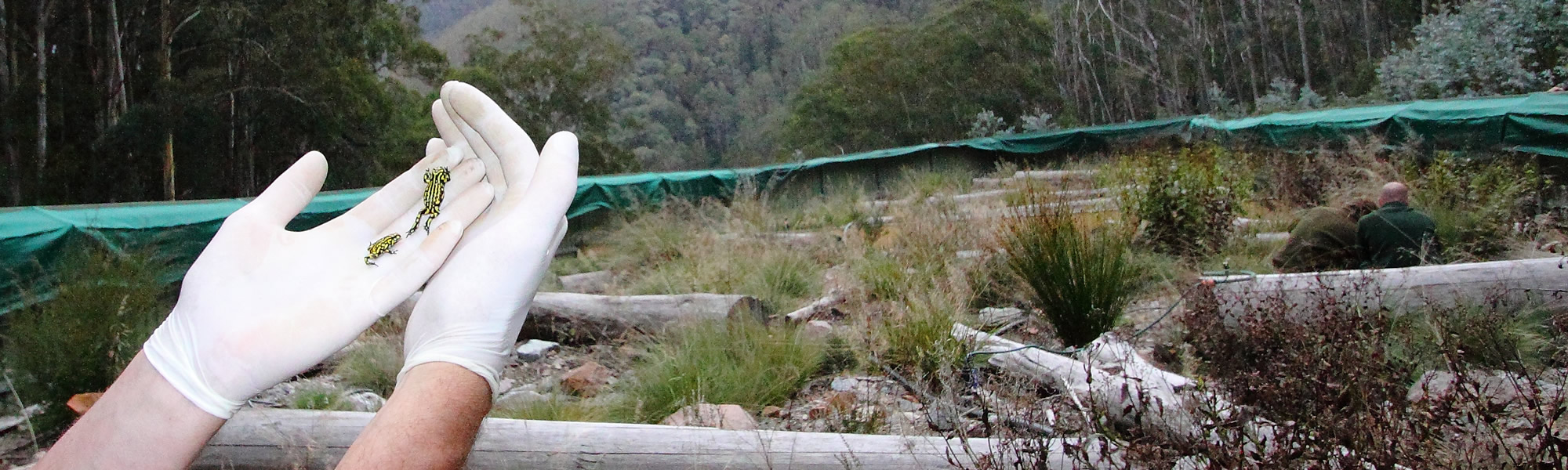
Saving the Corroboree Frogs will require helping these species to develop resistance to the Amphibian Chytrid Fungus. The Australian government has developed a plan for saving species threatened with extinction from this disease (click here to download this plan). A major part of this plan is to assist wild populations develop resistance to the fungus through breeding individuals in captivity and reintroduing them back into the wild.

Captive Breeding of Corroboree Frogs >>